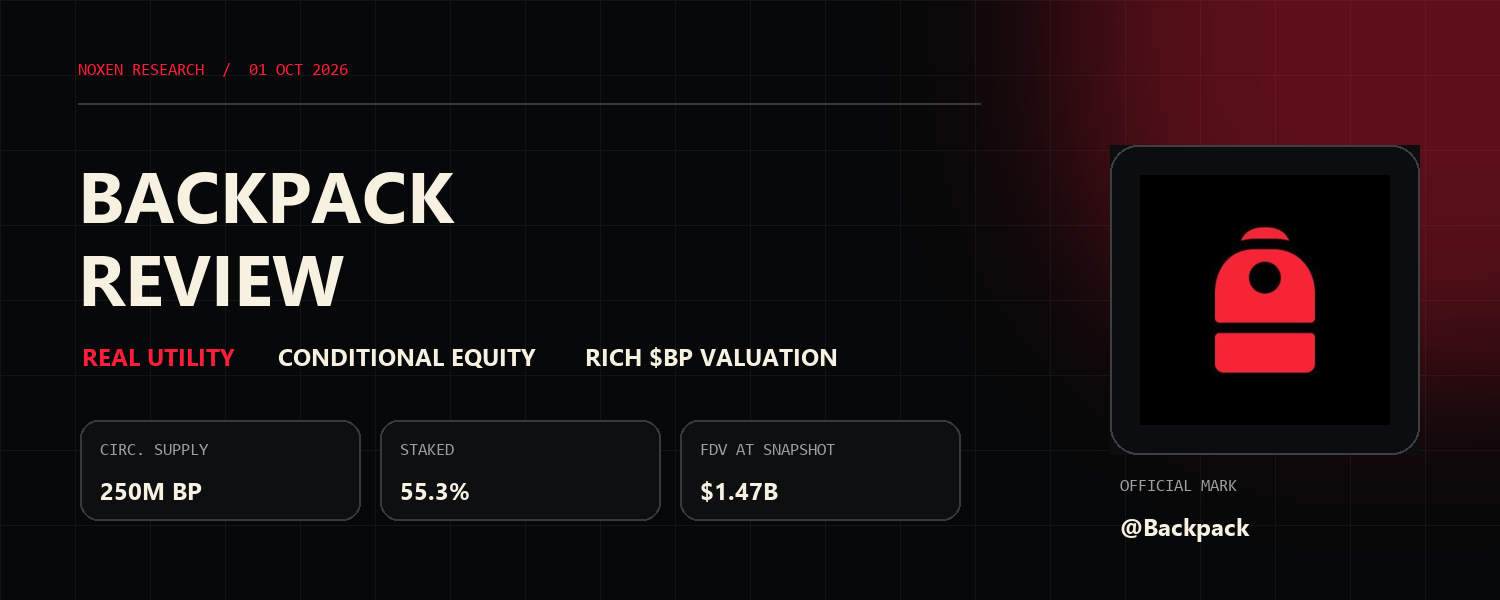
Research date: 1 October 2026
Official account: @Backpack
Asset: $BP on Solana
Official mint: BPxxfRCXkUVhig4HS1Lh7kZqV6SPJhzfEk4x6fVBjPCy
Reference market: Backpack Exchange BP/USDC spot
Reference price: $1.4668 at 06:27 UTC on 1 October 2026
Executive summary
Backpack has built one of the more ambitious exchange-token models in crypto. The company operates a centralized exchange, a self-custody wallet, lending and derivatives products, and a developing securities platform. Its native token, $BP, provides fee discounts, transfer benefits, product access, and a conditional path through which eligible long-term stakers may sell BP to purchase equity connected to Backpack's operating companies.
That last feature is the core of the investment story, but it is often simplified too aggressively. Staking BP does not automatically make a holder a shareholder. The governing terms require continuous staking, monthly platform activity, jurisdictional eligibility, and an eventual qualifying exit event. Equity is delivered through special-purpose vehicles, may be subject to investor-qualification rules, and the program can be modified, suspended, or terminated under the published terms.
The token structure is unusual in a positive way. Backpack says no direct token allocation went to founders, employees, or equity investors. Of the fixed one-billion-token supply, 25% was distributed to users at launch, 37.5% is intended for pre-IPO growth-triggered user distributions, and 37.5% is reserved for a corporate treasury that stays locked until one year after an IPO.
The market has already assigned a substantial value to this design. At $1.4668 and 250 million circulating BP, the implied circulating market capitalization was about $366.7 million. Fully diluted value was about $1.47 billion. Backpack's official API reported a 25.33% 24-hour rise, a $1.08792 to $1.59 range, about $5.16 million in quote volume, and 20,814 trades.
Our conclusion is split:
- Product bias, 12 to 24 months: constructive.
- Token bias, 4 to 12 weeks: neutral and wait after a rapid repricing.
- Directional stance: bullish momentum, but not buy-leaning at the reference price without either a successful retest or a confirmed breakout.
- Reason: Backpack has shipped real products and given BP measurable platform utility, while the equity feature remains conditional and the token now carries a rich fully diluted valuation.
1. What Backpack has built
Backpack began with a self-custody wallet and expanded into a centralized exchange. The current product stack includes spot and perpetual markets, lending and borrowing, staking, prediction products, a wallet, and Backpack Securities.
The exchange exposes public market data through an official API. That matters because price, volume, order-book, and candlestick data can be checked directly rather than inferred from promotional screenshots. Backpack also maintains an official open-source Rust API client.
Backpack Securities extends the strategy beyond crypto. Backpack says eligible users can buy and hold U.S. securities through traditional brokerage infrastructure, receive security entitlements governed by New York UCC Article 8, and move between traditional entitlements and tokenized representations on Solana. This is a more substantive product direction than simply attaching a token to an exchange.
The caution is legal perimeter. A product offered by one regulated entity or in one jurisdiction does not make every Backpack product globally available or governed by the same license. Availability, investor protection, and recourse depend on the specific entity, product, and user location.
Backpack reports more than $400 billion in cumulative trading volume and service across more than 150 countries. Those figures show claimed scale, but they are first-party cumulative metrics rather than independently audited revenue, active-user, or profitability data.
2. What $BP actually does
BP is more than a governance label. The live Backpack Participant Program lists several operational benefits for stakers:
- reduced spot and derivatives trading fees;
- reduced or waived fiat and asset withdrawal fees, subject to tier and jurisdiction;
- priority or enhanced allocation for platform launches and new products;
- additional USD yield for eligible tiers;
- wallet swap-fee reductions;
- access to the equity purchase mechanism.
The first five benefits can create recurring utility if Backpack retains active traders and expands eligible products. Fee savings are easiest to value because an active user can compare the cost of staking with the fees avoided. Product access is harder to value because allocations are not guaranteed and can change.
The official program page showed 138.34 million BP staked, equal to 55.3% of the 250 million circulating supply at the time of review. A high staked share reduces liquid float, which can support price during demand shocks. It also increases the risk of abrupt liquidity changes if participants unstake after incentives weaken. The published terms impose a seven-day unstaking period, and unstaked tokens stop accruing benefits when the request is made.
3. Tokenomics: community-first, with discretionary future supply
BP has a fixed total supply of one billion tokens. The official allocation is divided into three phases.
TGE: 250 million BP
At launch, 240 million BP went to Backpack Points participants and 10 million went to Mad Lads holders. Backpack states that founders, employees, and investors received no direct token allocation.
This is a meaningful alignment decision. Early users received the liquid supply, while the team and equity investors remained exposed through company ownership rather than a separate liquid token grant.
Pre-IPO: 375 million BP
This allocation is intended for users and is described as progressively unlocked when Backpack reaches regulatory, product, and market-access milestones.
The direction is positive, but the disclosure is not yet precise enough for a complete dilution model. Investors need a public schedule showing each milestone, the number of tokens attached to it, who determines completion, the distribution method, and the expected timing. Without that schedule, 37.5% of supply is both a growth incentive and a valuation uncertainty.
Post-IPO treasury: 375 million BP
The corporate treasury remains locked until one year after an IPO. Backpack describes it as strategic treasury rather than a team allocation.
This delays immediate dilution but does not remove it. A treasury holding can fund growth, acquisitions, incentives, or liquidity. Its economic effect depends on future governance and deployment. The one-year post-IPO lock creates a clear minimum timing condition, while the eventual use of those tokens remains a major long-term variable.
4. The equity mechanism, without the marketing shortcut
Backpack's equity feature is distinctive, but the legal structure matters more than the headline.
Base phase
An eligible user must continuously stake BP for at least one year. The base formula allocates a pro rata right to purchase from an equity pool equal to 12.5% of the Backpack Companies' equity as measured against 625 million pre-IPO tokens.
For illustration, one million qualifying BP represents:
1,000,000 / 625,000,000 x 12.5% = 0.02%
That is a right to purchase the calculated equity through the program if all conditions are met. It is not an automatic 0.02% direct shareholding from the first day of staking.
Bonus phase
After the first year, qualifying tokens accrue additional rights daily for up to three more years. The bonus pool represents another 7.5% of company equity across the 625 million pre-IPO tokens.
If the same one million BP remains qualifying for the full four-year period, the combined illustrative amount becomes:
1,000,000 / 625,000,000 x 20% = 0.032%
At the reference token price, acquiring one million BP would cost about $1.47 million before trading costs. That cost cannot be compared directly with 0.032% of company equity because the company valuation, exit timing, dilution, taxes, eligibility, and token value at exchange are unknown.
The conditions that matter
The published terms add several conditions:
- The user must remain a Monthly Active User by completing at least one qualifying platform action each calendar month.
- Tokens must remain continuously staked through the election process.
- The user must satisfy jurisdictional and investor-qualification rules.
- A qualifying IPO, acquisition, asset sale, or other recognized exit event must occur.
- The holder sells qualifying BP to Backpack in exchange for interests in designated special-purpose vehicles.
- Exchanged BP loses its staking history and future claim.
- Equity can be diluted through future share issuance.
- Backpack reserves broad rights to modify, suspend, restructure, or terminate program benefits.
The terms also state that the equity purchase option is not a guaranteed right inherent in the token. This does not make the program meaningless. It means the correct valuation is a probability-weighted benefit rather than a fixed entitlement.
5. Strengths
A shipped, integrated product stack
Backpack has moved beyond a wallet and a spot exchange. Lending, derivatives, securities, tokenization, and unified collateral create several ways for active users to generate platform revenue and receive BP benefits.
Direct utility for active customers
Fee and transfer discounts can be measured by users. That gives BP a demand channel tied to platform activity rather than relying only on governance or narrative.
Community distribution
The absence of direct founder, employee, and investor token allocations reduces one common source of early selling pressure. It also makes the distinction between company equity and token ownership clearer.
Public market infrastructure
Backpack provides official market APIs, candlesticks, order-book data, and an official Rust client. That improves independent verification and makes the exchange easier to integrate.
A differentiated equity experiment
The program attempts to connect long-term product participation with company ownership. Even with its conditions, this is more ambitious than a standard exchange token built around fee discounts alone.
6. Weaknesses and risks
The equity benefit is conditional and discretionary
Staking alone is insufficient. Users need continuous activity, eligibility, a qualifying exit, and compliance with terms that can change. The benefit may be unavailable in some jurisdictions or to users who fail investor-classification requirements.
Future unlocks are not fully schedulable
The 375 million pre-IPO tokens are linked to growth milestones, but public disclosure does not yet provide a conventional dated unlock schedule. That limits supply forecasting.
FDV is already substantial
At $1.4668, BP's fully diluted value was about $1.47 billion. The token therefore needs sustained platform growth, credible benefits, and disciplined future distributions to justify further appreciation. A good product does not automatically make every token price attractive.
Staking can reduce exit flexibility
More than half of circulating supply was staked. The seven-day unstaking period and loss of equity accrual after an unstake request create real opportunity cost during a fast market move.
Company information remains incomplete for equity valuation
Token holders do not receive a public company income statement, audited valuation, or IPO timetable through the token pages. Without revenue, profitability, balance-sheet, and cap-table visibility, the equity component cannot be valued like a listed security.
Regulatory coverage is fragmented
Backpack operates through multiple entities and product-specific frameworks. Users should verify which entity serves them and what protections apply. A license attached to one operation should not be generalized to every product or jurisdiction.
First-party growth figures need independent context
Cumulative volume can be large while current active users, revenue, or profitability remain unknown. The most useful future disclosures would include active funded accounts, net revenue, trading concentration, assets on platform, and audited financial information.
7. Market structure and price scenarios
Backpack's official BP/USDC ticker showed $1.4668 at 06:27 UTC on 1 October 2026. The 24-hour range was $1.08792 to $1.59, price was up 25.33%, quote volume was about $5.16 million, and the venue recorded 20,814 trades.
The official four-hour candle series placed the 20-period average near $1.25, the 50-period average near $1.19, and the 100-period average near $0.91. Price was therefore extended above all three after a sharp advance. The seven-day low-to-current move was large, and the latest candle had already rejected from $1.59.
Base case, 4 to 12 weeks
- Range: $1.15 to $1.60.
- Stance: neutral, wait.
- Activation: price holds the $1.10 to $1.20 zone but cannot sustain a four-hour close above $1.59.
- Interpretation: momentum cools while the market tests whether new demand can absorb profit-taking.
- Invalidation: a sustained close outside the range with expanding venue volume.
Bull case
- Range: $1.80 to $2.10.
- Stance: bullish and buy-leaning only after confirmation.
- Activation: a four-hour close above $1.59 followed by a successful retest of approximately $1.45 to $1.55.
- Evidence needed: continued official-market volume, stable staking participation, and clearer disclosure of program tiers or growth-triggered unlocks.
- Invalidation: a four-hour close below $1.35 after activation.
Bear case
- Range: $0.82 to $1.05.
- Stance: bearish and sell-leaning after breakdown.
- Activation: a daily close below $1.08, the 24-hour reference low.
- Mechanism: a crowded momentum trade unwinds while stakers and liquid holders reassess a roughly $1.47 billion FDV.
- Invalidation: a daily close back above $1.25.
Current bias: bullish momentum, neutral and wait on entry. The market is above its recent averages, but the reference price followed a 25% one-day move and sits below an intraday rejection at $1.59. A confirmed breakout or controlled retest offers better evidence than chasing the vertical move.
These scenarios are conditional analytical ranges. They are not promises and do not establish executable prices for large orders.
8. What would strengthen the thesis
We would become more constructive on BP if Backpack delivers several measurable improvements:
- Publish a milestone-by-milestone schedule for the 375 million pre-IPO tokens.
- Publish stable BP tier thresholds and quantify the fee savings available at each level.
- Report audited or independently verified operating metrics, including active users and revenue.
- Clarify which jurisdictions and investor categories can access the equity program.
- Demonstrate sustained demand for Backpack Securities and its tokenization rails.
- Maintain strong BP/USDC depth while circulating supply expands.
- Preserve program economics without repeatedly changing eligibility or benefits.
The thesis would weaken if benefits are reduced materially, milestone unlocks become opaque, staked participation falls sharply, venue liquidity deteriorates, or the equity program becomes inaccessible to a large share of otherwise qualifying users.
9. Noxen scorecard and final bias
| Category | Score | Assessment |
|---|---|---|
| Product execution | 8.5/10 | Exchange, wallet, lending, derivatives, and securities products are live or rolling out |
| Token utility | 8.0/10 | Fee, transfer, access, yield, wallet, and conditional equity benefits |
| Distribution design | 8.0/10 | Community-led TGE with no direct founder, employee, or investor token allocation |
| Transparency | 7.0/10 | Strong API and program documentation, but limited financial disclosure and unlock detail |
| Equity-program certainty | 4.5/10 | Novel and potentially valuable, but conditional, jurisdiction-dependent, and modifiable |
| Market structure | 6.5/10 | Active official market and meaningful staking, with concentrated liquid supply |
| Current risk-reward | 5.0/10 | Strong momentum after a sharp move, with a roughly $1.47 billion FDV |
Final bias: constructive on Backpack as a product company, neutral and wait on BP at $1.4668. The token has real utility and a genuinely differentiated long-term program. The market is also pricing a significant amount of future success before investors have full visibility into company financials, program eligibility, and pre-IPO unlock timing.
The clean bull thesis is not simply that BP can become equity. It is that Backpack grows into a durable, regulated multi-asset platform, keeps the program accessible, distributes future supply transparently, and converts platform usage into recurring reasons to hold or stake BP. Until those conditions are clearer, the best stance is conditional rather than promotional.
Primary sources
- Backpack BP program dashboard
- Backpack Participant Program overview
- BP Program FAQ
- Backpack Participant Program Terms and Conditions
- Backpack tokenomics
- Official BP mint and launch details
- BP trading launch
- How to claim and stake BP
- Backpack IPO access description
- Introducing Backpack Securities
- Backpack company and product timeline
- Backpack Exchange API documentation
- Official Backpack API client
- Official BP/USDC ticker endpoint
- Official BP/USDC candlestick endpoint
- BP/USDC on Dex Screener
Data checked on 1 October 2026. Market data changes continuously. Product scale figures identified as Backpack-reported were not treated as audited financial results.