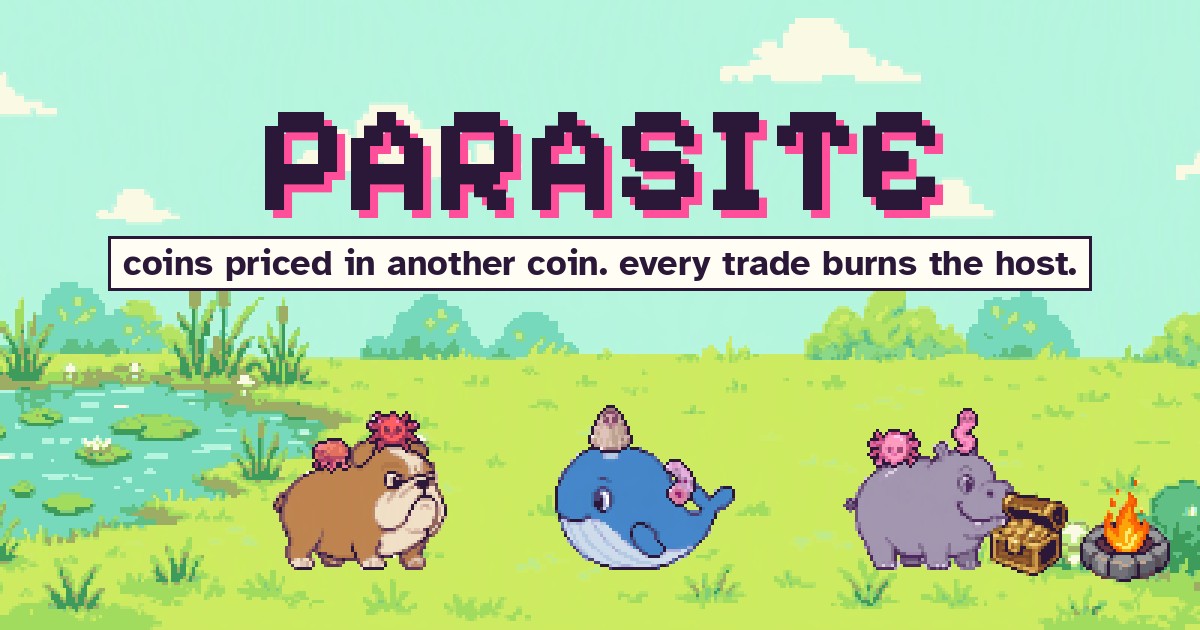
A full review of @parasitedotfun, its host-token architecture, early onchain traction, and why the design is more interesting than a standard meme coin launchpad.
Most meme coin launchpads use SOL as the universal quote asset. Parasite changes that relationship.
Every Parasite coin trades against another token called its host. Buying the Parasite therefore requires the host token, while every trade charges a 1% fee in that host. Part of the fee is permanently burned. The result is a launchpad where speculative activity can create measurable demand and supply reduction for an existing token.
That single design choice gives Parasite a stronger economic identity than another factory for isolated tokens.
How the mechanism works
A creator selects an eligible Solana token as the host, launches a Parasite with a fixed supply of 1 billion tokens, and optionally includes a first buy in the same transaction.
The Parasite uses Token-2022 with six decimals, no mint authority, no freeze authority, and immutable metadata. These are sensible defaults for a permissionless launch product because the supply cannot later be expanded and holders cannot be frozen by the creator.
Trading takes place against the chosen host token. A 1% fee is charged in the host token. According to the current protocol documentation, Meteora keeps 20% of that fee. The remaining 80% is allocated as follows:
- 50% burns the host token
- 30% goes to the Parasite creator
- 20% goes to the protocol treasury
Measured against gross trading volume, the effective allocation is 0.40% to host burns, 0.24% to the creator, 0.16% to the treasury, and 0.20% to Meteora.
This is the core advantage: volume is converted into an observable onchain outcome instead of disappearing entirely into platform fees.
Why the host model is compelling
The host model creates three aligned participants.
First, Parasite traders get a market with a clear narrative and a direct relationship to another token. Second, creators earn a share of the trading fees. Third, host communities can benefit from ongoing burns when Parasites built on their token generate activity.
The architecture can also form chains. A Parasite can become a host for another token, up to a current maximum depth of three. A route may therefore look like SOL to host to Parasite. That makes Parasite less like a list of unrelated launches and more like a composable market graph.
This recursive structure is unusual. If it develops real usage, successful branches could reinforce their parent assets through repeated fee flows.
Graduation has a durable design
A Parasite graduates after its curve accumulates 85 SOL worth of host tokens under the protocol's pricing rules, subject to the documented cap of 50% of the host supply.
After graduation, liquidity moves to a Meteora DAMM v2 pool. The liquidity position remains locked to the program, and LP fees continue to feed the host. This matters because the economic link does not end when the bonding curve finishes.
The launch flow also allows the creator's first buy to be included atomically. This reduces the gap between token creation and the initial transaction, although buyers should still evaluate concentration and routing costs independently.
Early traction is visible onchain
At 06:39 UTC on September 29, 2026, the official stats page reported:
- 11 host tokens
- 74 Parasites
- 33.2 SOL fed to hosts
- 4,155 SOL of volume measured in host tokens
- 16.6 SOL worth of host tokens burned
The main PARASITE host page showed 48 Parasites, 1.99 million PARASITE fed through fees, and about 994,800 PARASITE burned, equal to roughly 0.0995% of supply. These values are onchain protocol statistics, not projections.
The PARASITE market itself also showed strong early attention. A DEX Screener snapshot around the same period displayed roughly $6.4 million of 24-hour volume, 79,000 transactions, 7,700 traders, and about $116,000 of liquidity. Those figures can change rapidly and should be treated as a point-in-time snapshot.
The strongest parts of the project
Parasite's best feature is transparent value routing. The protocol defines who receives each part of the fee, while the host burn can be checked onchain.
Its second strength is composability. Any eligible token with sufficient liquidity can become a host, so communities can launch experiments tied to their own asset rather than competing only for SOL liquidity.
Third, the token defaults remove several common creator controls. Fixed supply, disabled mint and freeze authorities, and immutable metadata reduce obvious post-launch manipulation vectors.
Fourth, graduated liquidity remains locked and keeps feeding the host. That extends the mechanism beyond the bonding curve stage.
Fifth, the public statistics make the thesis measurable. Hosts, launches, volume, fees, burns, and graduation status can be tracked instead of relying only on promotional claims.
Finally, the onchain program is designed to keep existing trading, feeding, and claims operational even if the front end is unavailable. That is an important property for a crypto-native product.
Why PARASITE can benefit
PARASITE benefits directly when it is selected as the host. Activity in those branches charges fees in PARASITE and sends part of those fees to permanent burns.
The relationship is specific, not automatic. A launch hosted by another token burns that other host, not PARASITE. The long-term value capture for PARASITE therefore depends on how often creators choose it as a host, how much durable volume those branches generate, and whether the protocol keeps PARASITE central to discovery and routing.
This is still a credible advantage. The current data shows PARASITE already hosts the largest visible branch of the ecosystem, with 48 Parasites at the snapshot time.
What still needs to mature
The project is extremely young. The official dashboard showed zero graduations at the reviewed snapshot, so the complete graduation and post-graduation fee loop has not yet been demonstrated at scale.
I also did not find a public independent security audit or a verified source repository in the official materials reviewed. Publishing both would make the program easier to evaluate. Clear disclosure of admin and treasury controls, ideally with multisig or timelock details, would further improve trust.
Better cohort metrics would help separate durable adoption from launch-week activity. Useful additions include daily active traders, new versus returning wallets, bot-adjusted volume, median launch survival, concentration by host, and the graduation funnel.
Multi-hop routes also create extra slippage and execution cost. Showing the full route, total fee, price impact, and minimum received before signature would make that tradeoff easier for users to understand.
Verdict
Parasite is one of the more original Solana launchpad experiments because its core mechanic is economically legible: trade a child token, route fees through its host, and permanently burn part of the host supply.
The protocol already has a working product, measurable onchain activity, and a design that aligns traders, creators, and host communities. Its strongest opportunity is to become infrastructure for token communities that want launches to contribute to their own asset rather than merely borrow attention from it.
The next proof points are security transparency, sustained repeat usage, successful graduations, and evidence that activity remains organic after the initial launch cycle. If those arrive, @parasitedotfun could become more than a meme coin launchpad. It could become a network of token economies connected by verifiable fee flows.
Sources
- Parasite protocol documentation: https://parasiteonsol.fun/docs
- Parasite onchain statistics: https://parasiteonsol.fun/stats
- PARASITE host dashboard: https://parasiteonsol.fun/h/3kmygWKZBkCYrgZHKfiuB9UFKTcDLTFFsKo3BWpmpump
- PARASITE market snapshot: https://dexscreener.com/solana/3kmygWKZBkCYrgZHKfiuB9UFKTcDLTFFsKo3BWpmpump
- Parasite program: https://solscan.io/address/ParuAAGRhp2sVVRW9UBdW269vjkdSqY1tYKyUUH5XSi