Research date: 1 October 2026
Account reviewed: @quantnetwork
Asset: $QNT
Reference market: Coinbase QNT-USD
Reference price: $294.76 at 03:07:55 UTC on 1 October 2026
Executive summary
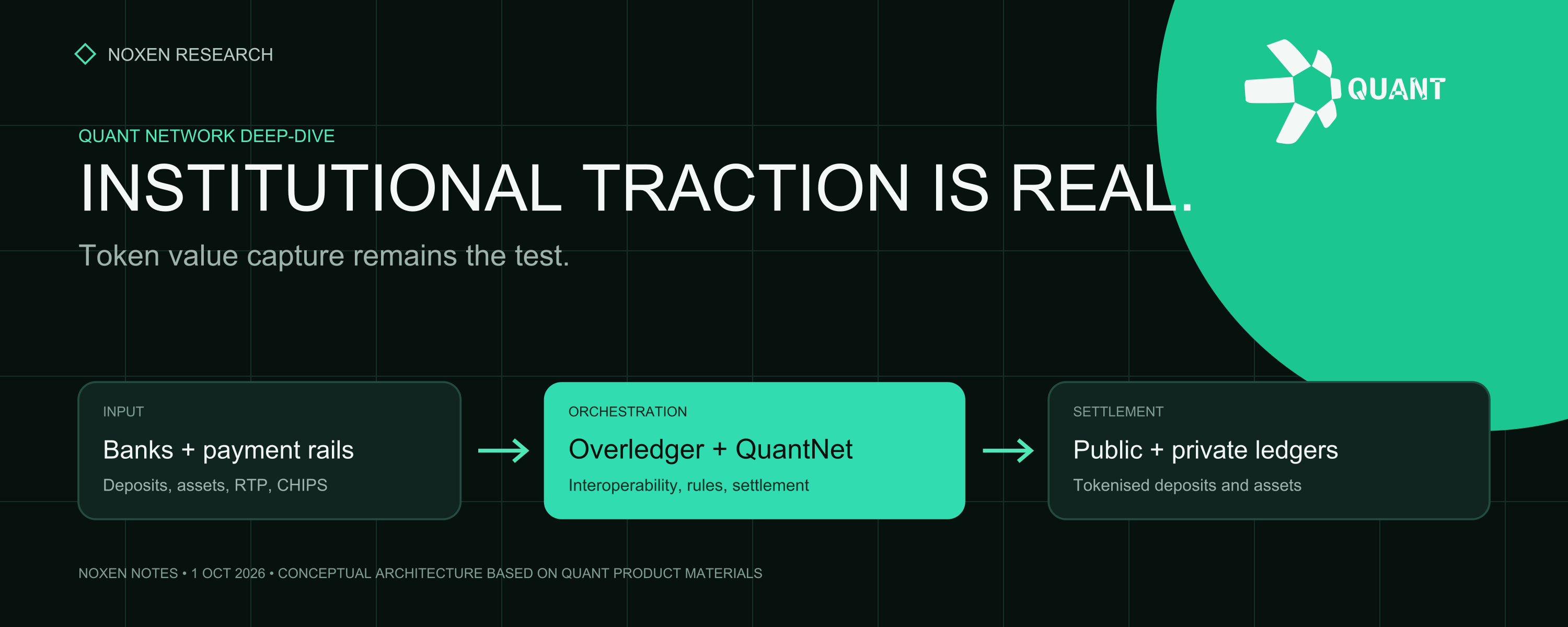
Quant Network is building infrastructure that connects banks, payment systems, traditional applications, and multiple blockchains through a common API and orchestration layer. Its core products are Overledger, QuantNet, Quant Flow, and Quant Fusion.
The strongest part of the thesis is execution with regulated institutions. The Great British Tokenised Deposit initiative completed live customer transactions on infrastructure developed by Quant. The Clearing House selected Quant to power the interoperability, orchestration, and transaction-management layer of its On-Chain Money Initiative. Project Rosalind also gave Quant experience in central-bank digital-currency API infrastructure, although that project was experimental and is now concluded.
The weakest part of the investment thesis is not the product. It is the link between product adoption and $QNT value capture. Quant says QNT can be used for subscriptions and staking, and Quant Fusion uses QNT as its native staking asset. However, customers can also pay platform fees in USD, commercial pricing is not public, and Quant does not publish enough usage, revenue, fee-conversion, node, or staking data to model how institutional adoption translates into recurring token demand.
Our conclusion is therefore split:
- Business and technology bias, 12 to 24 months: constructive to bullish.
- Token bias at the current price, weeks to months: neutral and wait.
- Reason: the institutional evidence is improving, but $QNT rose from roughly $64 on 18 September to an intraday high of $372 on 27 September. At $294.76, the market is already discounting substantial future success.
1. What Quant is building
Overledger
Overledger is a proprietary, API-based interoperability platform. It acts as an abstraction and orchestration layer between existing financial systems and blockchains. Instead of rebuilding an application for every ledger, an institution can use standard interfaces for functions such as asset issuance, cross-chain transactions, smart-contract deployment, and integration with existing systems.
This design targets a real enterprise problem. Banks do not want their core infrastructure tied to one public chain, one private ledger, or one vendor-specific settlement network. They also need identity, access controls, auditability, compliance rules, and links to existing payment rails.
Overledger's strongest architectural idea is that it does not require every connected network to adopt the same consensus mechanism. It coordinates activity above the underlying ledgers. That can reduce integration work and allow institutions to change or add networks without rebuilding the complete application stack.
The trade-off is dependence on Quant's proprietary platform, APIs, gateway operations, and commercial terms. Customers gain a simpler integration layer, but they introduce a vendor and orchestration layer that must remain available, secure, compliant, and competitively priced.
QuantNet
QuantNet is presented as ISO 20022-native settlement infrastructure for tokenised deposits, programmable fund distribution, and post-trade automation. It is designed to coordinate regulated participants and support workflows such as delivery versus payment and payment versus payment.
This is a practical institutional positioning. Quant is not trying to replace every bank account with a public cryptocurrency. It is helping regulated institutions represent commercial-bank money and assets digitally while preserving rulebooks, identity controls, and existing payment-system connectivity.
Quant Fusion
Quant Fusion extends the architecture toward public-chain activity through a multi-ledger rollup and trusted-node model. Quant states that QNT is the native token and staking mechanism for trusted nodes, with operators staking QNT to process transactions and earn rewards based on network activity.
This could materially improve token utility if network activity, active nodes, QNT staked, fees, and rewards become measurable at scale. The current weakness is disclosure. The reviewed official sources describe the mechanism, but do not provide a complete public dashboard of node count, stake concentration, transaction activity, fee generation, or reward economics.
2. Evidence that the technology is being used
Great British Tokenised Deposit initiative
This is the clearest current proof point. UK Finance says seven banks participated: Barclays, HSBC UK, Lloyds Banking Group, Monzo, Nationwide, NatWest, and Santander. In September 2026, the initiative completed live retail transactions using tokenised sterling deposits, including two remortgage completions and a consumer marketplace transaction.
UK Finance states that the GBTD platform was developed by Quant as shared UK industry infrastructure. These were live customer transactions, which is stronger evidence than a memorandum, sandbox, or conference demonstration. Still, the activity was a defined pilot. Transaction volume, commercial revenue, margins, and the path to system-wide production use are not public.
The Clearing House On-Chain Money Initiative
On 24 September 2026, The Clearing House announced that it selected Quant to power its new interoperable tokenised-deposit network. Quant's layer is expected to coordinate interoperability, orchestration, and transaction management while connecting to existing payment systems, including RTP and CHIPS.
This is strategically significant because The Clearing House operates US payment networks that collectively clear and settle more than $2 trillion per day. That figure describes The Clearing House's existing networks. It does not mean Quant currently processes $2 trillion per day.
The network is expected to become available to participating institutions in the first half of 2027. Until it launches and reports real participation and transaction activity, this remains a high-quality forward contract or implementation mandate rather than proven production volume.
Project Rosalind
Project Rosalind explored APIs for a potential retail central-bank digital currency with the BIS Innovation Hub and Bank of England. Quant worked as a technology vendor alongside UST.
The project demonstrated relevant technical capability, but its scope must be stated correctly. BIS describes it as a concluded experiment. It did not represent a Bank of England commitment to launch a CBDC, select Quant for a future national system, or adopt a final policy design.
Oracle integration
Quant and Oracle announced an integration involving Overledger and Oracle Blockchain Platform Digital Assets. The combination targets tokenisation, interoperability, programmable payments, and enterprise workflows.
This expands distribution potential and enterprise credibility. It does not, by itself, disclose customer numbers, recurring revenue, transaction volume, or guaranteed adoption. Partnership announcements should be treated as channels and capabilities until usage data appears.
3. The role of $QNT
$QNT is an ERC-20 utility token. The Ethereum contract reported a total supply of 45,467,000 QNT when queried on 1 October 2026.
Official Quant materials establish three current or proposed utility paths:
- Customers may use QNT to subscribe to Quant services.
- QNT is the only digital asset Quant accepts for access when a customer chooses to pay with a digital asset.
- Quant Fusion uses QNT as its native token and staking mechanism for trusted nodes.
The critical limitation is that Quant's FAQ also says customers can pay platform fees in USD. That creates an unanswered value-capture question: when a customer pays in fiat, how much QNT is purchased, held, locked, burned, or otherwise removed from liquid supply, and for how long?
Without public data on subscription conversion, enterprise licensing, transaction fees, staking participation, reward emissions, or treasury flows, it is not possible to build a reliable cash-flow-style valuation for QNT. Company success can support the narrative and may create token demand, but the relationship is not equivalent to owning equity in Quant Network Limited.
4. What Quant does well
Institutional problem selection
Quant focuses on expensive and persistent problems: fragmented ledgers, legacy-system integration, programmable settlement, tokenised deposits, and compliance across networks. These are more durable problems than short-lived retail narratives.
API-first integration
Banks already use APIs, identity systems, rulebooks, and controlled infrastructure. An abstraction layer can be easier to procure and integrate than a complete replacement of the core banking stack.
Credible counterparties
UK Finance, seven UK banks, The Clearing House, BIS project work, and Oracle are material references. They do not prove future profits, but they meaningfully reduce the probability that Quant is only a conceptual whitepaper project.
Chain neutrality
An institution may not know which public or private networks will dominate in five years. Multi-ledger orchestration reduces the need to make one irreversible chain bet today.
Compliance-aware design
Permissioning, identity, audit trails, and policy enforcement are necessary for regulated money. Quant is building for those constraints rather than assuming institutions will abandon them.
5. Weaknesses and risks
Token value capture is under-disclosed
This is the largest issue for token investors. Product adoption is visible, but the economic bridge from customer activity to sustained QNT demand is not sufficiently measurable.
Proprietary and centralised dependencies
Overledger is commercial middleware rather than an entirely permissionless public protocol. Quant controls product access, APIs, documentation, pricing, upgrades, and parts of the operating environment. That is often acceptable to banks, but it adds vendor concentration and limits independent verification.
Limited operating metrics
Quant is private. The reviewed public sources do not provide audited segment revenue, customer concentration, margins, backlog, live transaction volume, Fusion node count, QNT staked, or fee yield. Investors must avoid filling those gaps with assumptions.
Implementation risk
Institutional infrastructure moves slowly. Procurement, regulation, legal design, integration, testing, and participant onboarding can delay deployment. The Clearing House initiative is targeted for the first half of 2027, not fully live today.
Competition
Quant competes for interoperability and orchestration budgets against blockchain-native protocols, messaging systems, custody and infrastructure vendors, enterprise DLT platforms, cloud providers, and internal bank technology teams. Chainlink CCIP, Axelar, LayerZero, Swift-linked initiatives, R3-based systems, and bespoke bank middleware are different products, but they compete for parts of the same problem.
Quant's strongest moat would be production integrations, regulatory trust, shared rulebooks, and high switching costs. Its weakest moat would be a generic API layer that institutions can replace or reproduce. The outcome depends on usage depth, not the number of announced relationships.
Security and operational opacity
Quant says its smart-token contracts are externally tested and its platform is designed for enterprise security. However, a proprietary stack cannot be assessed with the same public transparency as a fully open-source protocol. Institutional due diligence may exist privately, but public investors have limited access to it.
Market risk after a parabolic move
QNT traded around $64 on 18 September, reached $372 intraday on 27 September, and was $294.76 at 03:07:55 UTC on 1 October. A rapid repricing can continue, but it also creates wide downside ranges, crowded positioning, and sensitivity to any delay or weaker-than-expected adoption evidence.
6. Market structure and scenarios
Coinbase daily QNT-USD data through 1 October showed:
- Reference price: $294.76
- 24-hour range at the data check: $273.42 to $329.15
- Recent intraday peak: $372 on 27 September
- 20-day simple moving average: $124.38
- 50-day simple moving average: $87.28
- 200-day simple moving average: $74.00
- Approximate 30-day return: +367.9%
The moving averages are far below price because the advance was extremely fast. That is momentum, but it is also extension risk.
Base case, next 4 to 12 weeks
QNT consolidates between roughly $230 and $330 while the market digests the September repricing. The constructive fundamental news remains intact, but price needs time to form support and produce higher-quality entries.
Bias: neutral, wait.
Bull case
A daily close above $330, followed by acceptance above that level with sustained volume, would reopen a test of $372. A confirmed break above $372 would indicate that the market is pricing a faster institutional-adoption path.
Activation: daily close above $330, then hold on a retest.
Invalidation: loss of $286 after the breakout attempt.
Bear case
A daily close below $230 would weaken the post-spike structure and expose the $195 to $205 area. Failure there could open a deeper retracement toward $150 to $160, near the earlier breakout zone.
Activation: daily close below $230.
Invalidation: recovery and acceptance back above $286.
These ranges are scenario boundaries, not certainty. After a move of this size, intraday volatility and slippage can be substantial.
7. What would make us more bullish
We would increase our token conviction if Quant reports several of the following:
- The Clearing House network launches on schedule with named participating institutions.
- GBTD progresses from limited live pilots to recurring commercial transaction volume.
- Quant publishes measurable Fusion activity, active nodes, QNT staked, fees, and reward economics.
- Fiat-paid subscriptions create a transparent and recurring QNT purchase or lock mechanism.
- Public customer usage expands without heavy dependence on one project or jurisdiction.
- Price forms a multi-week base instead of relying on vertical momentum.
8. What would invalidate the thesis
Our constructive fundamental view would weaken if the US initiative is delayed materially, GBTD does not progress beyond pilots, disclosed activity remains minimal, major institutions build competing internal infrastructure, or the QNT utility mechanism fails to create measurable demand.
Our current neutral market bias would turn bearish on sustained acceptance below $230, especially if accompanied by weaker volume, delayed deployments, or evidence that September's move was mostly speculative.
Final assessment
Quant is one of the more credible enterprise-interoperability projects because it has moved beyond generic partnership language into regulated pilot activity and a significant US implementation mandate. Its product strategy fits how banks actually operate: multiple systems, strict permissions, existing payment rails, and gradual migration rather than wholesale replacement.
But a strong company narrative is not automatically a strong token entry. Investors need clearer evidence that platform usage creates durable QNT demand. At the same time, the token's September repricing has moved much faster than the available operating data.
Noxen scorecard:
- Institutional execution: 8.5/10
- Product-market relevance: 8/10
- Technical differentiation: 7.5/10
- Public operating transparency: 5/10
- Token value-capture transparency: 5/10
- Current risk/reward after the September surge: 4/10
Our bias: fundamentally constructive to bullish over 12 to 24 months, but neutral and wait on $QNT at $294.76. We prefer either a confirmed breakout and retest above $330 or a controlled consolidation that establishes support. We would not chase a vertical move purely because the institutional story is credible.
Primary sources
- Quant, Overledger: https://quant.network/overledger-platform/
- Quant, QuantNet: https://quant.network/quant-net/
- Quant, FAQ and payment options: https://quant.network/frequently-asked-questions/
- Quant, service terms and QNT utility: https://quant.network/terms-and-conditions/
- Quant, Fusion and trusted-node staking: https://quant.network/use-cases/why-institutions-need-layer-2-5-and-why-we-built-it/
- The Clearing House, On-Chain Money Initiative: https://www.theclearinghouse.org/payment-systems/Articles/2026/09/The-Clearing-House-Partners-with-Quant-to-Advance-the--On-Chain-Money-Initiative
- UK Finance, Great British Tokenised Deposit initiative: https://www.ukfinance.org.uk/tokenised-sterling-deposits-gbtd-initiative
- BIS, Project Rosalind: https://www.bis.org/project/rosalind
- Quant, Oracle integration: https://quant.network/news/quant-partners-with-oracle-to-drive-digital-assets-innovation/
- Coinbase Exchange direct QNT-USD market data: https://api.exchange.coinbase.com/products/QNT-USD/ticker
- Ethereum QNT contract: https://etherscan.io/token/0x4a220e6096b25eadb88358cb44068A3248254675