Research date: 1 October 2026
Account reviewed: @QuantusNetwork
Asset: QTC
Reference market: Independent SafeTrade QUANTUS/USDT secondary market; no official Quantus endorsement found
Reference price: $82.702 at approximately 03:46 UTC on 1 October 2026
Executive summary
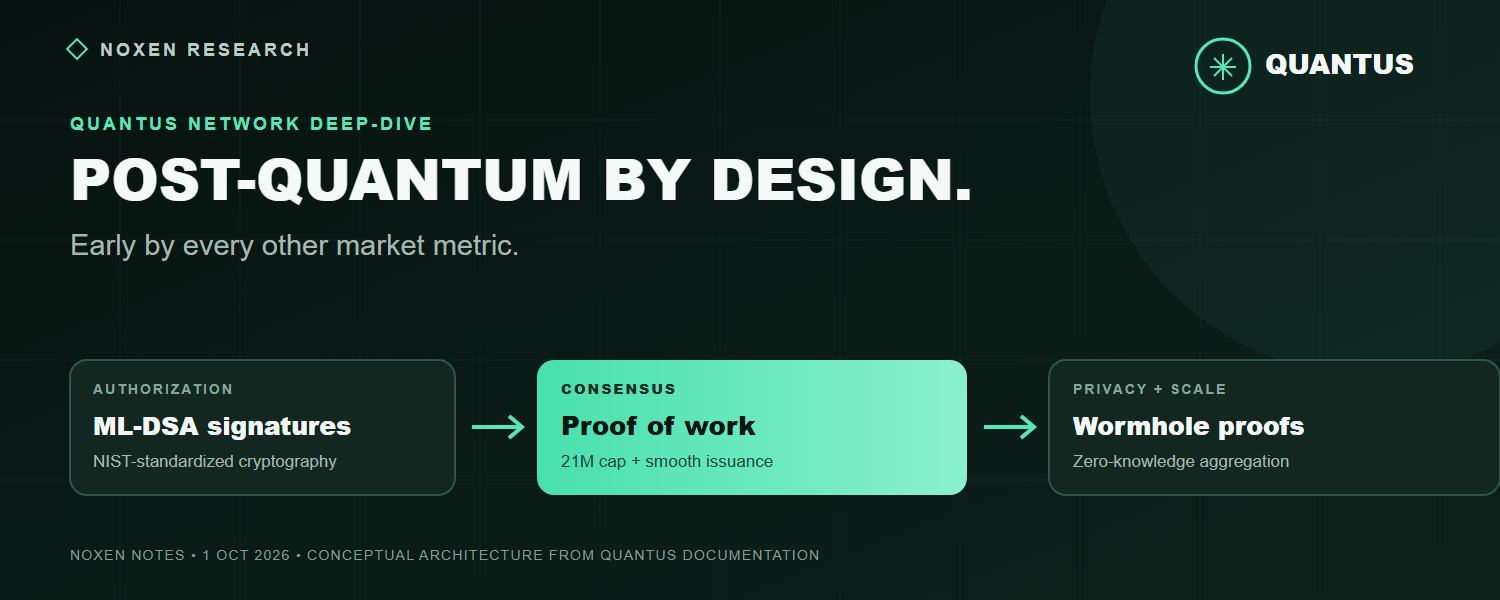
Quantus Network is a purpose-built proof-of-work Layer 1 for post-quantum, privacy-preserving digital money. It is not trying to be a general-purpose smart-contract platform. Its design combines NIST-standardized post-quantum signatures, encrypted peer-to-peer communication, proof-of-work mining, zero-knowledge transaction aggregation, and account-level recovery controls.
The engineering thesis is credible. Mainnet launched on 9 September 2026, the code is public, development is active, and the network has already processed transparent transfers and zero-knowledge proofs. The choice of ML-DSA and ML-KEM aligns with NIST standards rather than proprietary cryptography.
The investment thesis is much less mature. A real QTC secondary market exists on SafeTrade, with native-network deposits and withdrawals enabled, but we found no official Quantus endorsement of that listing. Quantus instead identifies NEAR Intents as the first planned venue for access to QTC following mainnet, and its documentation still marks that integration as in development. Only about 1.03% of the 21 million maximum supply is currently counted as circulating, most genesis tokens remain in a vesting pool, public audit-report access is incomplete, and the independent market has less than one month of price history. At $82.702, QTC had risen about 362% from its 18 September daily reference and sat about 10.7% below its reported all-time high.
Our conclusion is split:
- Technology bias, 12 to 24 months: constructive.
- Token bias, 4 to 12 weeks: neutral and wait.
- Reason: Quantus is solving a real long-term cryptographic migration problem, but the token's current float, venue concentration, audit visibility, documentation inconsistencies, and vertical price move make the market risk unusually high.
1. What Quantus is building
Quantus is designed as digital money rather than a general application chain. The whitepaper compares its scope more closely with Bitcoin, Monero, and Zcash than with Ethereum. This narrower design is a strength if the goal is secure money, but it also limits the number of applications that can generate demand directly on the base layer.
Post-quantum signatures and networking
Quantus uses the Module-Lattice-Based Digital Signature Algorithm, or ML-DSA, for transaction authorization and ML-KEM for encrypted peer-to-peer communication. NIST finalized ML-DSA as FIPS 204 in August 2024. That gives Quantus a stronger standards foundation than a chain built around an unstandardized quantum-resistant scheme.
Post-quantum security has costs. Quantus documentation estimates an ML-DSA transaction signature at roughly 4,627 bytes and a public key at roughly 2,592 bytes. That is far larger than common elliptic-curve signatures. The network therefore needs aggregation and careful bandwidth management to remain usable.
The phrase "quantum secure" also requires discipline. NIST says current quantum computers are not large or stable enough to break today's widely deployed public-key cryptography, and no one knows when a cryptographically relevant quantum computer will arrive. Quantus is an early migration architecture for a possible future threat, not evidence that existing major chains are being broken today.
Wormhole privacy and scaling
Quantus addresses large post-quantum transactions through Wormhole, a zero-knowledge burn-and-remint system. Transactions are aggregated inside proofs, reducing on-chain data and obscuring the direct link between sender and receiver.
Official documentation reports about 430 quantum-secure transactions per second with current aggregation, compared with roughly 43 transparent ML-DSA transactions per second. It also describes a theoretical ceiling near 2,800 transactions per second under more aggressive batching.
Those figures are engineering estimates, not independently verified production throughput. Privacy is also bounded: Wormhole can hide the sender-to-receiver link, but the balance of a known receiving address can still be visible. It is more accurate to call this link privacy than complete transactional invisibility.
Account safety
Quantus includes optional delayed transfers, guardian cancellation, and recovery controls. These features address a practical weakness of self-custody: a mathematically valid signature can still come from a stolen device, malware, or social engineering.
The design is differentiated because it treats wallet recovery and theft response as protocol problems. The trade-off is added complexity. Guardians, delays, and recovery paths create more state and more implementation surfaces that must be audited carefully.
2. What has actually shipped
Mainnet launched on 9 September 2026. In its first-week update, the team reported more than 53,000 blocks, 3,546 accounts, 11,645 transparent transfers, and 4,011 zero-knowledge proofs that settled 19,248 private payments. It also reported more than 7,000 GPUs at launch and average network hash rate of 11.2 TH/s.
These metrics are useful evidence of a functioning network, but they are team-reported launch statistics. They should not be treated as independently audited adoption or sustained economic demand.
The open-source evidence is stronger. Quantus maintains a public GitHub organization with dozens of repositories. The main chain repository is written primarily in Rust, uses a Substrate architecture, and continued receiving releases after mainnet. This makes the protocol materially more inspectable than a closed-source token project.
The live supply endpoint showed block 143,383 and 3,850 accounts at 03:25 UTC on 1 October. It reported 215,295.26 QTC as circulating and 5,713,760.26 QTC as total issuance. The difference is mostly the undistributed vesting-pallet balance.
3. Official access versus the SafeTrade market
Quantus mainnet is live, but that does not mean its official market-access route is live. On 22 September, the official Quantus account described NEAR Intents as the first venue planned for access to QTC following the 9 September mainnet launch. Four days earlier, it said Quantus would be live on NEAR Intents "soon." The official website still labels "Get QTC" as coming soon, and the technical documentation marks the NEAR Intents integration and supporting MPC node as in development. The current NEAR Intents supported-chain list does not include Quantus.
SafeTrade separately operates an active QUANTUS/USDT market. Its network-status page identifies the asset as Quantus (QTC), uses the native QUAN network, and showed both deposits and withdrawals enabled. Recent trades and volume were visible on the order book. This is evidence of a real secondary market for native QTC, rather than merely an unverified price ticker.
However, a search of the official @QuantusNetwork account found no SafeTrade announcement or endorsement. SafeTrade's own listing notice is the source claiming the listing. The correct classification is therefore:
- Mainnet status: live.
- SafeTrade market: real, active, and independently listed.
- Official Quantus market launch: not established by SafeTrade.
- First official access route announced by Quantus: NEAR Intents, still in development and not live at the time of review.
The SafeTrade last-trade price is valid for that venue, but it is not an official QTC launch price, a broad-market consensus price, or proof that NEAR access has opened.
4. Tokenomics and the documentation conflict
QTC has a maximum supply of 21 million. The current runtime source allocates 27% at genesis, equal to 5.67 million QTC, with the remaining 73% distributed through mining.
This matters because the public whitepaper version 0.4.0 says the genesis allocation is 25%, or 5.25 million QTC. The current mainnet vesting code and tokenomics documentation say 27%. For present supply analysis, the runtime is the stronger source of truth. The mismatch should still be corrected because investors should not need to inspect Rust code to learn the actual genesis allocation.
The runtime provides useful protections:
- Most spreadsheet-defined grants are locked for one year from launch and then vest over three years.
- A 210,000 QTC treasury-liquidity allocation vests over the first 16 days.
- A 42,000 QTC grant follows a separate one-year vesting schedule.
- The treasury uses a 6-of-10 multisignature account.
- Compile-time assertions check that the allocations reconcile with the 27% genesis amount.
At the live snapshot, circulating supply was about 215,295 QTC, only 1.03% of the maximum supply. Total issuance was about 5.714 million QTC because locked genesis tokens already exist on-chain but are excluded from the circulating calculation.
At $82.702, these different supply definitions produce radically different values:
- Circulating market-cap estimate: about $17.8 million.
- Value of total issued supply: about $472.5 million.
- Fully diluted value at 21 million QTC: about $1.74 billion.
This is the central market-structure risk. A small circulating float can amplify both rallies and declines. The vesting schedule delays most supply, but it does not remove future dilution.
5. What Quantus does well
Standards-based cryptography
Using NIST-standardized ML-DSA and ML-KEM is a strong architectural choice. It reduces reliance on proprietary claims and aligns the network with a broader global migration toward post-quantum cryptography.
A focused monetary design
Quantus avoids the complexity of a general-purpose smart-contract environment. Fewer application surfaces can make security reasoning easier and keep development focused on transfers, privacy, mining, and custody.
Public implementation
The chain code, runtime allocation logic, documentation, and releases are public. Researchers can compare marketing claims with implementation details. The 25% versus 27% discovery is an example of why this transparency matters.
A functioning mainnet
Quantus has progressed beyond a whitepaper and testnet. Blocks, accounts, mining, transparent transfers, and Wormhole proofs exist on a live network.
Practical custody controls
Delayed transfers, guardians, cancellation, and recovery are useful attempts to reduce irreversible loss. These controls could become a meaningful product advantage if they remain secure and understandable.
6. Weaknesses and risks
Audit visibility is incomplete
The official audit page lists completed reviews of Poseidon2, QPoW, and the ML-DSA implementation, but the report links are still marked pending. It also lists the zero-knowledge circuit and threshold-signature work as in progress. A security claim is easier to assess when the scope, findings, fixes, and retest results are public.
One exchange dominates price discovery
SafeTrade was the only active market found. The venue lists the Quantus pair as QUANTUS/USDT, even though the network token is called QTC. SafeTrade also has a different QTC/USDT market, creating symbol confusion. More importantly, this is an independent listing with no official Quantus endorsement found, while the project's announced NEAR Intents access route remains unfinished.
Single-venue pricing makes reported price, volume, and liquidity less robust. A modest order can move the market sharply, withdrawals can disrupt arbitrage, and there is no strong cross-venue check on price discovery.
The float is unusually small
Only about 1.03% of maximum supply was counted as circulating. That creates scarcity now but also makes the token sensitive to concentrated holders, exchange inventory, mining issuance, and future vesting.
Documentation is not synchronized
The 25% versus 27% allocation conflict is the clearest example. There is also inconsistent public wording around ML-DSA parameter sets. The team has published newer software and documentation after whitepaper version 0.4.0, but the investor-facing documents should identify one current specification and archive obsolete figures.
The privacy and bridge roadmap is unfinished
The NEAR Intents integration and threshold-signature bridge are described as planned or in development. The related audit is in progress. These are potential catalysts, not current production capabilities.
Governance is still early
Quantus plans a transition toward a technical collective, but the project is still young and major development, documentation, release, and treasury decisions remain concentrated around the founding organization and early participants.
Demand is unproven
Quantum migration is a legitimate long-term security problem. That does not guarantee near-term user demand for a new monetary network. Quantus must still compete on wallet usability, liquidity, merchant acceptance, custody, mining security, privacy, and distribution.
7. Market structure and price scenarios
The direct SafeTrade reference price was $82.702 at approximately 03:46 UTC on 1 October 2026. The venue displayed about 4,870.79 QUANTUS and 347,278.76 USDT of 24-hour activity, with recent trades visible. CoinGecko reported an all-time high near $92.57. These figures describe the independent SafeTrade book only.
The market history is extremely short. QTC rose from a daily reference near $17.89 on 18 September to $82.702, a gain of about 362%. It also rose about 177% from the 28 September daily reference near $29.89. Traditional moving-average analysis is not meaningful with this little history, so the scenarios below use observed price zones and explicit activation conditions. They apply only to the independent SafeTrade market and should not be interpreted as an official launch valuation.
Base case, 4 to 12 weeks
- Range: $55 to $90.
- Stance: neutral, wait.
- Activation: price holds above the late-September breakout area near $55 but fails to sustain a daily close above $93.
- Interpretation: the market digests a vertical move while liquidity and circulating supply grow.
- Invalidation: a sustained daily close outside the range.
Bull case
- Range: $105 to $125.
- Stance: bullish and buy-leaning only after confirmation.
- Activation: a daily close above $93, followed by a successful retest of $90 to $93, with volume remaining materially above the pre-breakout baseline.
- Evidence needed: public audit reports, another credible market venue, continued account growth, or a shipped bridge would strengthen the breakout.
- Invalidation: a daily close below $78 after activation.
Bear case
- Range: $38 to $55, with $28 to $30 as the next historical area if $38 fails.
- Stance: bearish and sell-leaning after breakdown.
- Activation: a daily close below $55.
- Mechanism: thin liquidity and a small float can reverse a vertical rally quickly when marginal demand weakens.
- Invalidation: a daily close back above $70.
These are conditional scenarios, not promises or personalized financial advice. The exchange price can diverge sharply from executable size because the market is thin.
8. What would make the thesis stronger
We would become more constructive on the token if several measurable conditions improve:
- Completed audit reports become public with findings, fixes, and retest status.
- The whitepaper, tokenomics page, runtime, and cryptography documentation use the same current figures.
- Trading expands to multiple credible venues with visible depth and reliable withdrawals.
- The Wormhole circuit and threshold-signature bridge complete their audits and ship.
- Accounts, private payments, mining participation, and merchant use continue growing after the launch period.
- Price forms a stable base while circulating supply increases, instead of relying on an extremely small float.
The thesis would weaken if critical audit findings remain unresolved, the bridge launches before adequate review, network activity fades after incentives, mining becomes concentrated, or token distribution and treasury movements become less transparent.
9. Noxen scorecard and bias
| Category | Score | Assessment |
|---|---|---|
| Technical differentiation | 8.5/10 | Standards-based post-quantum money with privacy and recovery features |
| Shipped product | 7.5/10 | Live mainnet and observable on-chain activity |
| Open-source verifiability | 8.0/10 | Public chain, runtime, docs, and active releases |
| Security assurance | 5.5/10 | Audits are listed, but report access and ongoing work remain incomplete |
| Token transparency | 6.0/10 | Runtime is inspectable, but whitepaper and current allocation conflict |
| Liquidity and market structure | 2.5/10 | One independent venue, no official endorsement found, very small float, limited price history |
| Current risk-reward | 3.5/10 | Strong narrative after a rapid repricing, with weak liquidity support |
Final bias: constructive on the engineering, neutral and wait on QTC at $82.702 on the independent SafeTrade book. The bull case needs the official NEAR Intents route to launch, stronger audit transparency, broader liquidity, synchronized documentation, and evidence that usage persists beyond launch. The bearish risk is not that post-quantum security is irrelevant. It is that a credible technology can still be a poor entry when price discovery is concentrated, unofficial, and most supply is not circulating.
Primary sources
- Quantus website
- Quantus whitepaper v0.4.0
- Quantus documentation
- Post-quantum cryptography documentation
- Wormhole documentation
- NEAR integration status
- Official Quantus announcement naming NEAR Intents as the first planned QTC venue
- Official Quantus update saying NEAR Intents access is coming soon
- NEAR Intents supported chains
- Current mainnet vesting runtime
- Tokenomics documentation
- Audit status
- Quantus chain repository
- First-week mainnet update
- Live QTC supply methodology and snapshot
- NIST FIPS 204
- NIST post-quantum cryptography overview
- CoinGecko Quantus market data
- SafeTrade QUANTUS/USDT market
- SafeTrade Quantus listing notice
- SafeTrade network status
Data checked on 1 October 2026. Market data changes continuously. Team-reported metrics are identified as such, and market-cap calculations use the stated live supply methodology.